Water Filtration · Review
AquaTru Classic Alkaline Review: What to Know Before You Buy
The AquaTru Classic Alkaline is a compelling no-plumbing reverse-osmosis purifier for renters and countertop-first kitchens, but its footprint, batch workflow, filter costs, and hard-water limits deserve attention before you buy.
Quick verdict
AquaTru Classic Alkaline Countertop Water Purifier is our top pick
The published performance sheet, removable tanks, and mineral-boost finishing filter make a strong case for flexible countertop use. The tradeoff is a relatively large appliance that needs electricity, cleaning, filter replacements, and careful management of hard source water.
- Best for
- Renters, apartment kitchens, and households that want reverse osmosis without drilling or connecting a permanent water line.
- Avoid if
- Your untreated water hardness exceeds 10 grains per gallon, counter space is scarce, or you prefer an always-on plumbed system with no batch refilling.
- Main caveat
- This is a documentation-based evaluation, not a hands-on lab test. Local water chemistry, maintenance, filter condition, and operating practices affect real-world results.
Featured product
The product at a glance
Best for countertop RO without plumbing
AquaTru Classic Alkaline Countertop Water Purifier
Renters and households that want certified reverse-osmosis contaminant reduction plus a mineral-boost finishing filter without modifying the sink.
Tradeoff: It needs roughly 14 by 12 by 14 inches of counter space, a nearby outlet, recurring filter purchases, and extra maintenance where source water is hard.
Read the evidence
Why this product
AquaTru combines a documented reverse-osmosis treatment train with a format that does not require a landlord’s approval or a plumber. We selected the Classic Alkaline variant for this review because it adds a pH + Mineral Boost VOC finishing filter after reverse osmosis. That changes the taste and mineral profile, but it should not be treated as a medical benefit. The useful buying question is whether its certified performance, batch capacity, and installation flexibility outweigh the counter-space and maintenance commitments in your home.
What the AquaTru Classic Alkaline actually is
The Classic Alkaline is an electric countertop water purifier. You fill its removable tap-water tank, place it on the base, and the machine moves water through a multi-stage treatment path into a separate clean-water tank. Because it works in batches, it does not need a feed-water connection, drain saddle, faucet hole, or permanent change to the sink. It does need a standard outlet and enough clear counter area to remove, refill, and reinstall both tanks.
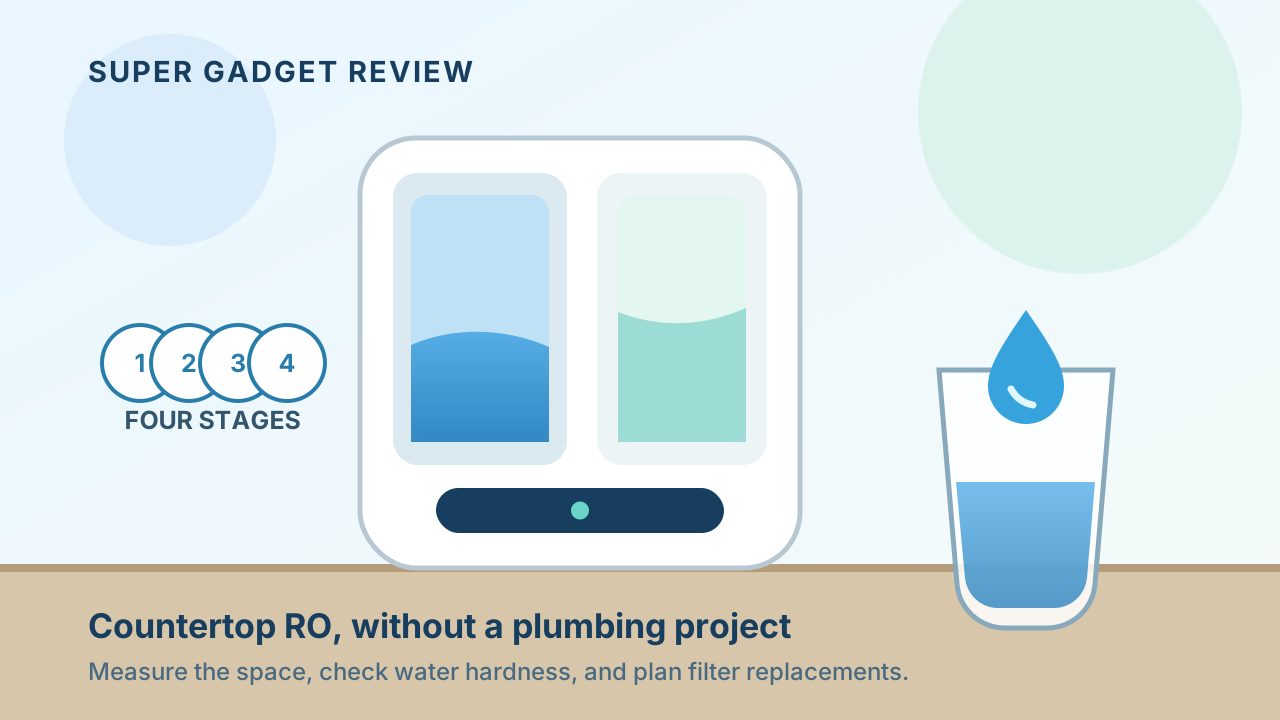
The product uses prefiltration and activated carbon ahead of a reverse-osmosis membrane, followed by a pH + Mineral Boost VOC carbon filter. AquaTru describes this as a four-stage system because its first cartridge performs more than one treatment function. The alkaline variant is not the Wi-Fi-equipped Classic Smart: it is the original Classic format with the mineral-boost finishing filter. That distinction matters if you expect app notifications or live TDS readings, because those are Smart-model features rather than standard Classic features.
- Countertop batch system with no permanent plumbing connection
- One-gallon tap-water tank and approximately three-quart clean-water tank
- Classic controls without the Smart model’s Wi-Fi monitoring
- Mineral-boost finishing filter in place of the standard VOC-only filter
Certified reduction claims need context
AquaTru’s current Classic and Connect performance data sheet lists testing under NSF/ANSI standards 42, 53, 58, and 401, plus protocol-based claims for additional substances. The tables report reductions for a long list that includes lead, fluoride, chromium, nitrate, VOCs, PFOA/PFOS, and microplastic-sized particles under the stated test conditions. That published detail is more useful than a vague claim that a filter makes water “pure.” It lets buyers match a specific concern to a named performance result.
Certification does not mean every home contains all listed contaminants, and it does not replace a local water-quality report or a laboratory test when a specific hazard is suspected. Performance also depends on using the correct cartridges, replacing them on schedule, keeping the system clean, and operating within the source-water limits in the manual. Treat the 84-contaminant headline as a summary of tested claims, then consult the performance sheet for the exact substance, test concentration, reduction, and conditions that matter to you.
- Start with your utility report or a qualified water test
- Match the contaminant of concern to the performance-data table
- Do not assume certification eliminates the need for maintenance
What the alkaline finishing filter changes
Reverse osmosis reduces dissolved material along with targeted contaminants. The Alkaline version routes treated water through AquaTru’s pH + Mineral Boost VOC carbon filter, which the company says adds calcium and magnesium and produces a more mineral-forward taste than its standard VOC filter. For shoppers who dislike the flatter taste sometimes associated with reverse-osmosis water, that finishing step is the practical reason to choose this version.
Avoid turning that feature into an unsupported health promise. Water pH and mineral content can vary with source water, cartridge age, and operating conditions, and the product documentation does not justify claiming that alkaline water treats disease or guarantees superior hydration. Choose the alkaline model for the intended flavor and mineral profile; choose the standard Classic if you specifically prefer a cleaner, less mineral-forward finish.
Counter space and daily workflow
AquaTru’s support documentation lists the Classic at about 14 inches high, 12 inches wide, and 14 inches deep. Measure more than the bare footprint. You need room above and around the appliance to lift the tanks, space in front to dispense water, and a path to the sink for filling and emptying. The one-gallon source tank produces water into a clean tank that holds roughly three quarts, so a heavy-use household may run more than one batch per day.
Reverse osmosis separates product water from a more concentrated residual stream. With this batch design, the remaining water stays in the tap tank and must be discarded rather than repeatedly topped up. The owner’s manual also calls for regular cleaning of both tanks. These steps are not difficult, but they are more hands-on than using a plumbed under-sink system or opening a refrigerator dispenser. The right buyer is comfortable making refilling and tank care part of the kitchen routine.
- Measure height, width, depth, lid clearance, and access to an outlet
- Plan for carrying a full source tank from the sink
- Empty residual water instead of adding fresh water on top of it
- Clean removable tanks on the schedule in the owner’s manual
Filter life and recurring ownership cost
AquaTru lists the Classic pre/carbon filter at six months or 600 gallons, whichever comes first. The reverse-osmosis cartridge is listed at two years or 1,200 gallons, while the VOC or pH + Mineral Boost VOC cartridge is listed at one year or 600 gallons. These are replacement limits, not promises that every cartridge will last exactly that long. Unusual sediment, hardness, chlorine exposure, cleaning habits, and daily volume can change practical service life.
Before buying, price the complete replacement schedule rather than only the purifier. Build a two-year estimate that includes two pre/carbon cartridges per year, one mineral-boost finishing cartridge per year, and the reverse-osmosis cartridge at its stated interval. Prices and bundles change, so we deliberately do not freeze a dollar estimate in this article. Check current cartridge availability and confirm that you are buying the Classic-compatible alkaline filter rather than the similar-looking Carafe or standard VOC cartridge.
The hard-water limit is an important caveat
The Classic manual sets a maximum hardness of 10 grains per gallon, or 171 mg/L, and AquaTru’s support guidance says water above that level can cause scale to build on the reverse-osmosis membrane. Scale can slow production and shorten membrane life. The company recommends softening water before it enters the purifier when hardness exceeds that limit, or following more frequent descaling guidance.
Do not guess based on white spots alone. Check a recent utility report or use an appropriate hardness test. A countertop reverse-osmosis purifier is not a whole-home softener, and the mineral-boost filter at the end does not protect the membrane from hardness entering at the beginning. If your source is private-well water or falls outside other inlet limits in the manual, get qualified water-treatment advice before relying on this unit.
The most meaningful tradeoffs
The AquaTru Classic Alkaline solves installation friction, not every inconvenience. Its footprint is larger than a pitcher, it occupies an outlet, and it processes water in batches. You still handle residual water and buy proprietary replacement cartridges. A single-product article cannot establish long-term reliability, noise, or support quality without controlled hands-on testing, so those factors should be checked through the current warranty, return policy, and recent verified-owner feedback before purchase.
The upside is equally concrete: renters can take it when they move, homeowners avoid altering plumbing, and the performance sheet provides contaminant-specific evidence. For a household whose main constraint is installation, those benefits can be more valuable than the lower visual impact and automatic operation of an under-sink system. For a large family with high daily demand, limited counters, or very hard water, a properly sized plumbed system may be the better long-term fit.
A five-minute pre-purchase check
First, identify the water issue you are trying to address and find it in the current performance sheet. Second, measure your counter and confirm access to power. Third, check hardness and other inlet limits. Fourth, price two years of replacement filters. Finally, confirm that the Amazon listing is still for ASIN B0F2GS6P8B, the Classic Alkaline variation, and review the current seller, return window, included cartridges, and warranty terms.
If all five checks work in your favor, the AquaTru Classic Alkaline has a coherent value proposition: documented reverse-osmosis performance, a mineral-boost finish, and no plumbing installation. If any check fails, pause before buying. A purifier that does not fit the source water, kitchen, maintenance budget, or household volume will not become a better choice simply because its contaminant list is long.
Best for countertop RO without plumbing
AquaTru Classic Alkaline Countertop Water Purifier

The AquaTru Classic Alkaline makes the most sense when installation flexibility matters as much as filtration. Its certification documents and no-plumbing design are meaningful advantages, but ownership still involves batch refilling, residual-water disposal, tank cleaning, and scheduled filter replacement.
What stands out
- No permanent plumbing or drilling required
- Four-stage reverse-osmosis treatment with a mineral-boost finishing filter
- Published performance data and filter replacement intervals
- Removable tap-water and clean-water tanks
Know before buying: It needs roughly 14 by 12 by 14 inches of counter space, a nearby outlet, recurring filter purchases, and extra maintenance where source water is hard.
Product details may be out of date; verify current details on the marketplace.
Check price on AmazonWhat to consider before buying
- Target contaminant
- Confirm that the current performance data sheet names the substance you care about and understand the stated test conditions.
- Source-water suitability
- Check hardness and the other inlet-water limits before purchase; this countertop purifier is not a substitute for pretreatment when water falls outside those limits.
- Kitchen fit
- Allow for the appliance footprint, tank-removal clearance, dispensing space, a nearby outlet, and a convenient route to the sink.
- Two-year maintenance budget
- Include every replacement cartridge, cleaning supplies, and any descaling or pretreatment your water requires.
- Household volume
- Decide whether a one-gallon source tank and roughly three-quart clean tank match daily drinking and cooking demand.
How we evaluated these products
We evaluated the exact Amazon variation identified by ASIN B0F2GS6P8B against AquaTru’s Classic/Connect performance data sheet, Classic owner’s manual, official specification, filter-life, alkaline-filter, and hard-water guidance. We checked the product identity and listing claims on September 21, 2026. We did not receive a review unit, perform hands-on measurements, test a water sample, verify current price, or infer medical benefits. Product availability, seller, warranty, filter prices, and certification scope should be rechecked before purchase.
Frequently asked questions
Does the AquaTru Classic Alkaline require plumbing?
No permanent plumbing connection is required. You manually fill the tap-water tank and place it on the powered countertop base. The unit still needs an electrical outlet and space to remove and carry the tanks.
How often do the filters need replacement?
AquaTru lists the pre/carbon filter at six months or 600 gallons, the reverse-osmosis filter at two years or 1,200 gallons, and the pH + Mineral Boost VOC filter at one year or 600 gallons, whichever limit comes first. Actual conditions can require earlier maintenance.
Can it be used with hard water?
The manual lists a maximum hardness of 10 grains per gallon, or 171 mg/L. AquaTru warns that harder water can scale the reverse-osmosis membrane and recommends softened feed water or more frequent descaling when hardness is higher.
Is the alkaline version the same as AquaTru Classic Smart?
No. “Alkaline” identifies the mineral-boost finishing-filter option. “Smart” identifies the Wi-Fi-connected model with app features. Amazon lists separate Classic, Classic Alkaline, Classic Smart, and Classic Smart Alkaline variations.
Does alkaline water provide proven health benefits?
This review makes no medical claim. The practical documented difference is that the finishing filter adds minerals such as calcium and magnesium and changes the water’s taste and pH profile. Consult qualified health guidance for medical questions.
Final recommendation
Buy the AquaTru Classic Alkaline if you want documented reverse-osmosis contaminant reduction, prefer a mineral-finished taste, cannot or do not want to alter plumbing, and are comfortable with batch refilling and scheduled filter costs. Skip it if your untreated water exceeds the stated hardness limit, your counter cannot spare the working clearance, or your household needs the automatic high-volume convenience of a plumbed system. Before ordering, verify ASIN B0F2GS6P8B, current seller and warranty details, the included alkaline filter, and the latest replacement-filter prices.
Sources
Primary references checked by the editorial team. Product availability and standards may change.
- AquaTru Classic Alkaline Countertop Water Purifier — ASIN B0F2GS6P8B — Amazon (accessed 2026-09-21)
- Classic and Connect Performance Data Sheet — AquaTru (accessed 2026-09-21)
- AquaTru Classic Owner’s Manual — AquaTru (accessed 2026-09-21)
- What Are the Dimensions and Specs of the AquaTru Units? — AquaTru Help Center (accessed 2026-09-21)
- What Is the Filter Life for Each Unit? — AquaTru Help Center (accessed 2026-09-21)
- Can AquaTru Filter Hard Water? — AquaTru Help Center (accessed 2026-09-21)
- Does AquaTru Produce Alkaline Water? — AquaTru Help Center (accessed 2026-09-21)